Emmarie Heredia ’22 ’24 is in her third year at G.W. Stout Elementary School in Silver City, New Mexico, where she teaches second-grade English Language Arts.
She’s also a student in NMSU’s Educational Leadership and Administration Doctoral Program, and while studying for her undergraduate degree in early childhood education at NMSU, served as the lead student assistant for the Glass Family Research Institute of Early Childhood Studies.
Overall, Heredia calls her experience at NMSU one that strengthened her ability to teach literacy to her second graders, a critical subject due to New Mexico’s low reading proficiency rates.
“I’ve gained tools to assess student progress, plan lessons that build foundational reading skills, and integrate writing and comprehension into daily practice,” Heredia says.
NMSU’s School of Teacher Preparation, Administration and Leadership has made great strides in recent years to elevate its preparation for future teachers in reading instruction and to align programming more directly with techniques associated with the science of reading and structured literacy approaches. Because of these efforts, NMSU has raised its national ranking to a B grade in Reading Foundations, according to a recent report released by the National Council on Teacher Quality. With this increased score, which is one of New Mexico’s highest among the state’s four-year universities, NCTQ has recognized NMSU’s success in ensuring all teacher preparation programs implement scientifically based reading instruction.
“TPAL has been focused on not only increasing its number of program completers in response to educator vacancies throughout the state, but also ensuring that new teachers are highly qualified to work with New Mexico students and equipped with cutting-edge pedagogical knowledge and research-based instructional skills,” College of Health, Education and Social Transformation Dean Rick Marlatt says. “We are grateful for strong support from the state, which has made our numerous successes possible and sustainable.”
Leanna Lucero, School of TPAL interim director, says the school’s emphasis in enhancing its literacy foci has been a catalyst for program growth in both quantity and quality. The increased awareness of structured literacy has coincided with a growth in enrollment. TPAL’s enrollment has grown 95% since 2018.
“Our faculty have worked hard to equip our preservice teachers with both foundational knowledge and practical experience in structured literacy, while remaining attentive to the needs of the culturally and linguistically diverse children and families we serve,” Lucero says.
That diversity is one of the main reasons why literacy among New Mexico students is so critical, Heredia says.
“Literacy is not only the foundation for all other learning, but also a pathway to opportunity, equity and confidence,” Heredia says. “For bilingual students and those from low-income or rural communities, strong literacy instruction can be life changing.”
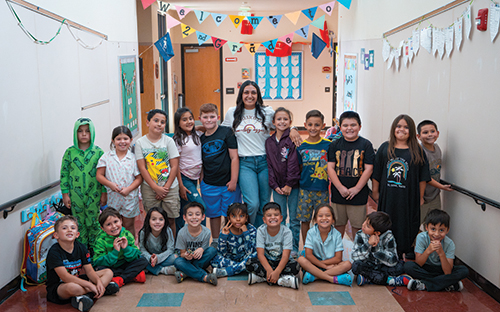
Emmarie Heredia is using her experience at NMSU to teach literacy to her second-grade class at G.W. Stout Elementary School in Silver City, New Mexico. Heredia calls literacy the foundation for all learning.



1305 N. Horseshoe Street
Las Cruces, NM 88003