A child and grandchild of immigrant labor workers from Mexico, Àngel Peña ’12 did not grow up seeing the outdoors as sacred space. By the time his parents’ workday was done, the last thing they wanted was to be outside again.
But when his grandfather started a landscaping business, he taught Peña that this was his way of taking care of the community: keeping outdoor living areas clean and safe.
Since 2019, Peña’s way of taking care of his community has been as executive director for the Las Cruces-based Nuestra Tierra Conservation Project, which advocates for historically and deliberately excluded communities to have equitable access to the outdoors and be part of land-management decision making.
“Community is a big part of conservation, including people for whom this land has been home, always,” Peña says.
Peña says Nuestra Tierra “started on the back of a napkin, with scribbled ideas about how to get kids outside.”
 Today, Peña’s team has an enviable track record of action-oriented initiatives that do just that, including spearheading the first-in-the-nation, state-funded Outdoor Equity Fund, which provides financial support to get young New Mexicans outside and interested and invested in land, water and heritage.
Peña, who has a bachelor’s in anthropology, says it was NMSU archeology Professor Will Walker who “got me so fired up about what’s right in our backyard. We found items buried for hundreds of years; it’s like time travel.”
As a graduate student doing cultural resource surveys for the New Mexico Wilderness Alliance, Peña partnered with youth groups, teaching them about research and opportunities to work outside as a scientist. During this time, he also discovered pictographs at Providence Cone, located in what is now the Organ Mountains-Desert Peaks National Monument, for which he was pivotal in mobilizing community support.
While doing archaeology for the NMWA, Peña says “All of a sudden, I was being called an organizer. I thought I was just doing science with kids. I was poached by a large land conservation organization and got to do what I did here across the country. That was when my theory of community-driven conservation developed: Get people outside together, learn their stories, make some memories and get kids involved. When they are involved, they care, and when they care as kids, they vote as grown-ups.”
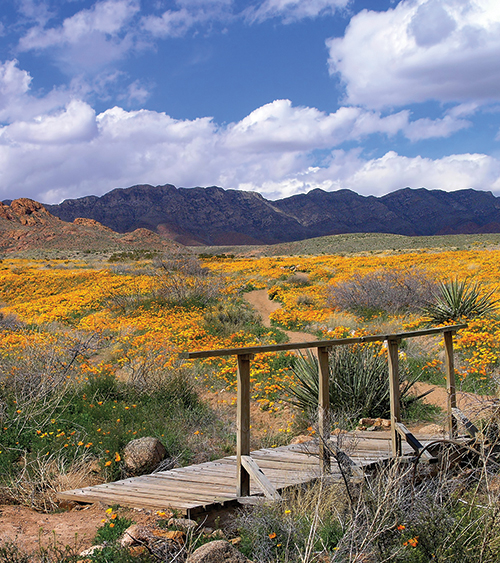
Recently, Peña’s efforts were decisive in obtaining community support for the 2023 designation of the Castner Range National Monument in West Texas, 7,000 acres of ecological significance that also contain artifacts and petroglyphs dating back 12,000 years.
“When folks don’t know what’s out there, they aren’t interested, which is why storytelling is so critical,” Peña says. “Our strategy is always to get kids outside. With the help of motivated teachers, we provide buses and food to get them outdoors to have fun and learn new skills. On the Castner range, they learned how to read a map and map the range. They made memories and shared their experiences on video.”
Peña’s idea of fun is no surprise.
“Our family hikes, camps, hunts and loves to have outdoor adventures,” he says. “My 4-month-old is just like me. When she gets grumpy, we take her outside and she’s happy again.”
NMSU is part of the Peña family tradition, too. In 2026, Peña’s oldest daughter will begin at NMSU as an anthropology major.
To find out more about Nuestra Tierra Conservation Project, visit nuestra-tierra.org.
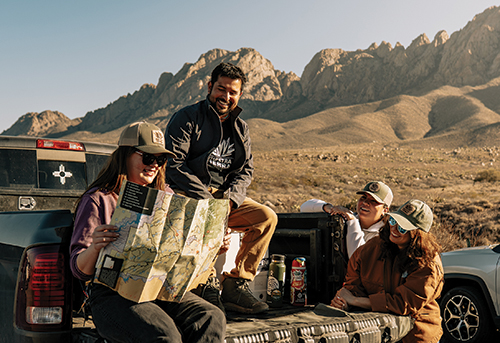
Àngel Peña, center, is the executive director of the Nuestra Tierra Conservation Project, which is based in Las Cruces.
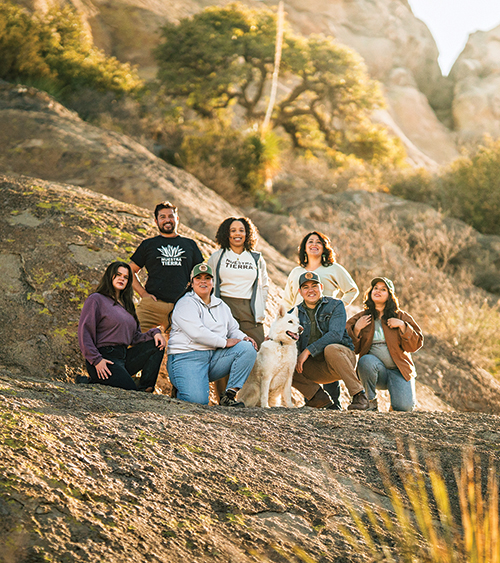
Àngel Peña, top left, and his team at Nuestra Tierra have played an instrumental role in land preservation statewide and beyond. He helped garner community support for the 2023 designation of the Castner Range National Monument in West Texas.

1305 N. Horseshoe Street
Las Cruces, NM 88003