When Kassandra Dominguez enrolled at Doña Ana Community College to study graphic design, she had a more ambitious goal in mind: earn a bachelor’s degree in agricultural communications from NMSU. What she didn’t expect was how seamless that journey would be.
“It’s definitely made college a lot easier for me in the whole transition to the main campus,” says Dominguez, who graduated from DACC in May 2026. “It also gave me the option to study online and do my courses at my own pace, which was definitely helpful. It’s made the experience a lot less intimidating.”
Dominguez is one of the first students to benefit from the DACC-to-ACES Aggie Pathway. The new initiative between DACC and the College of Agricultural, Consumer and Environmental Sciences maps clear, coordinated routes from four associate degree programs at DACC to 15 bachelor’s degree programs in agriculture-related fields at NMSU.
 The program is an expansion of NMSU’s broader Aggie Pathway Program, which makes it possible for students to begin their academic journey at any of NMSU’s three community colleges and transfer to the Las Cruces campus without losing time, credits or momentum. By aligning coursework, advising and degree requirements across both institutions, NMSU and DACC are giving students a clear roadmap from the start.
“One of the things we need to do as a university is find the easiest pathway for students to finish their degrees,” says Rolando A. Flores Galarza, College of ACES dean who retired in August 2026. “Our goal is for students to graduate as quickly as possible, ready to enter the workforce. With this program, students at the community college know what they have to do to graduate, starting from day one.”
That clarity translates to real savings. Because students know which credits transfer and when, they avoid the costly experience of repeating coursework or delaying graduation. Dominguez says starting at DACC also offered a meaningful financial advantage.
“It’s definitely a cheaper option,” she says. “It got me used to the pace of everything, and it’s helped me feel a lot more confident.”
The program offers two flexible models. Under the two-plus-two track, students complete two years at DACC before transitioning fully to NMSU. Meanwhile, students in the co-enrollment model take classes at both institutions during their first two years. Both options give students access to consistent support throughout their academic journey, including regular meetings with peer mentors, faculty advisers and student success staff.
“It’s a really exciting program where a student comes to DACC and says, ‘I want to be a DACC student, but I’m interested in a major in the College of ACES,’” says Mónica Torres ’82 ’84, chancellor of NMSU’s community colleges. “They’re simultaneously a DACC student while taking ACES classes on NMSU’s main campus.”
The DACC-to-ACES Pathway didn’t happen overnight. Torres and Flores Galarza led more than a year of close collaboration between faculty and staff at both institutions to identify compatible degree programs, align academic requirements and build the infrastructure for a truly coordinated experience. The result is a model that both leaders believe can be replicated across the NMSU system.
“This is nothing but an advantage for the university system, because we are able to introduce a whole new set of students to these four-year majors,” Torres says.
For more information about the DACC-to-ACES Pathway, visit nmsu.news/ACES-DACC.
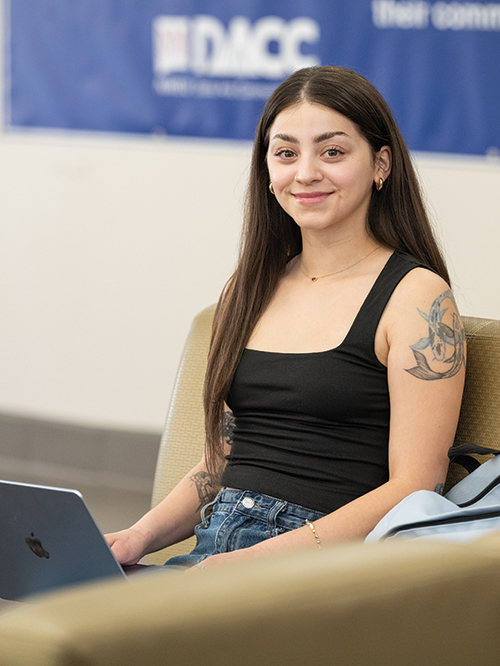
Kassandra Dominguez was one of the first students to participate in the DACC-to-ACES Aggie Pathway. The initiative maps clear, coordinated routes from four associate degree programs at Doña Ana Community College to 15 bachelor’s degree programs in agriculture-related fields at NMSU.
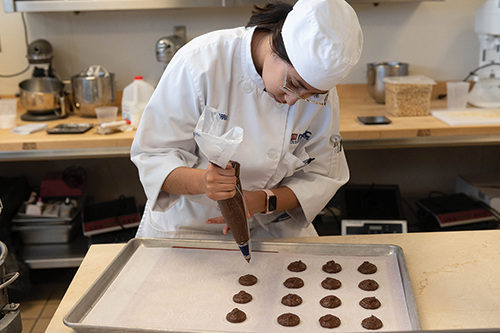
DACC’s Culinary Arts Program is one of four programs at DACC connected to ACES via the DACC-to-ACES Aggie Pathway. Cassandra Marrufo pipes out chocolate cream.

1305 N. Horseshoe Street
Las Cruces, NM 88003

