From the sides of buildings to bus stops and electrical boxes, murals adorn the streets of the Borderlands. In 2015, Norma Chairez-Hartell ’10 ’16 began a mission to document these murals and their stories. Today, the Murales Fronterizos project has catalogued more than 750 murals across Las Cruces and El Paso.
“Once you start looking at murals, you can’t stop,” Chairez-Hartell says. “You start seeing what’s important to people. There’s a lot of value in people’s identity, and how they see themselves in the murals.”
The project began in an NMSU public history class taught by former history Associate Professor Peter Kopp in the spring 2015 semester, for which history graduate student Jason Weisensel was documenting murals painted at NMSU during the Great Depression under the federal Works Progress Administration. Chairez-Hartell was documenting murals in Las Cruces. The two students combined their projects, and at the end of the class they took the project beyond NMSU and into the local community. Joined by Jerry Wallace ‘07, current director of the public history program and history assistant professor, the group expanded Murales Fronterizos into a multicity campaign to preserve the history of public art and the people, places and ideas reflected in each piece.
The team met with community members like U.S. Rep. Gabe Vasquez ’08, late Las Cruces City Councilor Miguel Silva ’90 and Saba, a well-known local graffiti artist, to define what constitutes a mural, who has ownership of it and how to best document them. Then, they divided Las Cruces into a grid and combed through the neighborhood to begin the documentation process.
In 2020 and 2023, Wallace was named a Mellon Faculty Fellow for the Humanities Collaborative between the University of Texas at El Paso and El Paso Community College. With the grant, they expanded their project to El Paso, adding more than 500 murals to their inventory.
“In my vision of this, we’re kind of like conduits,” Wallace says. “I want to create a digital archive where we’re preserving these murals so people can come back and see what artists were thinking about in 2016 or 2020 or 2025.”
The Murales Fronterizos project helps create a community timeline, preserving art in the time and place it was made. For example, a river mural might represent agriculture for one community and a place of crossing for another.
“Murals really reflect identity,” Chairez-Hartell says. “Anyone can go back to these archives and be able to see what was going on during this time period. It’s evidence of what was happening and what people’s sentiments were at that time.”
With new murals popping up and others painted over, there’s always something to add to the inventory. The ever-changing canvases of Las Cruces and El Paso continue to bring the Murales Fronterizos team back together — even the local community members are sending in tips and photos of new murals. In the future, Murales Fronterizos plans to include murals from Ciudad Juárez.
“The murals are often done by people that have long-standing roots in the community, and they’re often tying in these historical ideas about what that community has been over time,” Wallace says. “We’re hoping to keep this going, I’ve never thought that would end.”
To learn more about Murales Fronterizos, visit nmsu.link/murals.
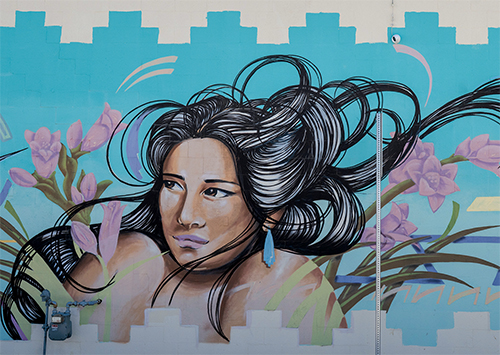
In downtown Las Cruces, “All Between Land and Air” depicts a woman with flowing hair surrounded by hummingbirds and plants.
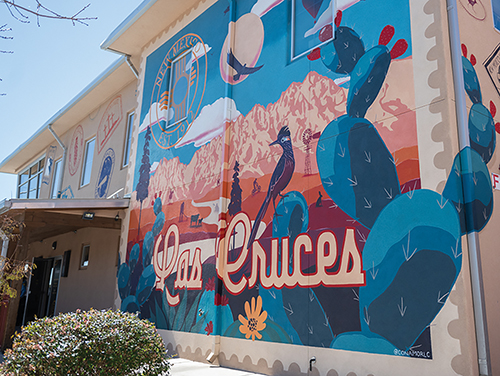
A mural of stamps and a large postcard adorns the side of the Visit Las Cruces building in downtown Las Cruces.

1305 N. Horseshoe Street
Las Cruces, NM 88003